
Beyond Lichtman’s Stairway: How SCALE Helps Leaders Create the Conditions for Change
I read the weekly Learning Forward Texas newsletter (free, by the way) and was reminded of the Complex Change model.
I hadn’t seen this translation by Grant Lichtman. (Link: https://www.learningforwardtexas.org/post/leading-change?utm_campaign=e36c2c26-9d82-4965-a713-761bf589fd73&utm_source=so&utm_medium=mail&cid=6d946965-bd83-4059-9cd7-2ba7aadbfe69)
Lichtman
Grant Lichtman’s Stairway of Successful Innovation is a diagnostic graphic showing the eight conditions needed for organizational change to succeed: Leadership, Vision, Inclusiveness, Timeline, Skills, Resources, Commitment, and Communication.
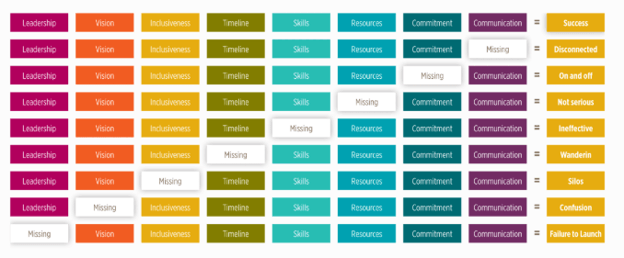
Lichtman’s Stairway helps leaders identify which condition may be missing. SCALE extends the model by helping leaders determine what to do about it, what people should begin doing differently, and how to know whether the condition is improving.
Lichtman identifies the conditions required for change. SCALE translates those conditions into intentional leadership actions, observable behaviors, evidence, and continuous improvement.
The SCALE diagnostic pathway
SCALE works backward from the results leaders are experiencing:
Result → Behavior → Condition → Leadership Action
For example:
Result: PLCs are inconsistent across teams.
Behavior: Some teams study student evidence; others handle announcements.
Condition: Clarity and implementation integrity are weak.
Leadership action: Define the essential PLC cycle, model it, provide a common protocol, monitor its use, and respond to evidence.
This prevents leaders from immediately labeling people as “resistant” or prescribing more training without first diagnosing the condition producing the problem.
How SCALE strengthens Lichtman’s conditions
SCALE strengthens Lichtman’s conditions by translating each one into intentional leadership practice. Leaders create a shared vision, involve the right people, establish realistic timelines, develop necessary skills, provide resources, build commitment, communicate consistently, and monitor whether these actions are producing the conditions needed for lasting change.
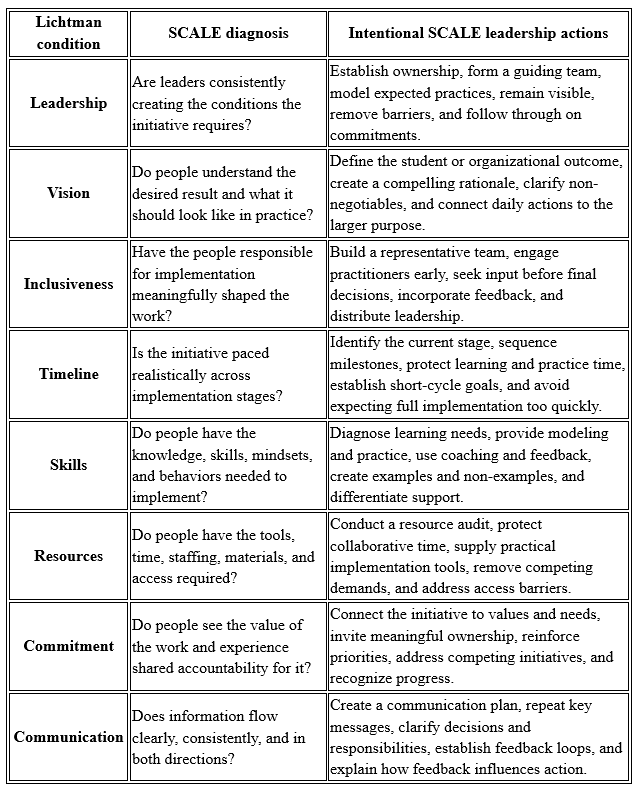
SCALE turns each condition into an implementation system
The five SCALE phases provide a pathway for acting on these conditions.
S — Set the Vision & Team
Leaders establish:
The problem or opportunity
The intended result
The people who must be involved
The values and evidence guiding the work
The initial conditions needed for success
This primarily strengthens leadership, vision, inclusiveness, and commitment.
C — Create the Script/Roadmap
Leaders translate the vision into:
Defined practices and non-negotiables
Roles and responsibilities
Professional-learning and coaching plans
Resources and protected time
Implementation stages and milestones
Observable evidence and integrity criteria
Communication and recognition plans
This strengthens clarity, timeline, skills, resources, and communication.
A — Act & Communicate
Leaders bring the plan to life by:
Modeling expectations
Communicating consistently
Providing opportunities to practice
Coaching and supporting implementation
Remaining visible
Reinforcing accountability
Removing emerging barriers
This turns planned conditions into people’s daily experience.
L — Learn, Listen, & Linger
Leaders determine whether their actions are actually producing the intended conditions by:
Gathering implementation evidence
Listening to practitioners
Examining differences across teams
Identifying root causes
Adjusting supports
Staying with the work long enough for practice to deepen
This prevents a condition from being assumed simply because leaders addressed it once.
E — Empower & Elevate
Leaders make the conditions sustainable by:
Developing teacher and team leadership
Sharing ownership
Building onboarding systems
Embedding routines into existing structures
Celebrating meaningful progress
Spreading effective practices without losing integrity
This moves the initiative from leader-dependent implementation to organizational capacity.
The role of SCALE’s Leadership Production Behaviors
The Leadership Production Behaviors, identified to make leadership more transparent and visible, provide an even more specific set of leadership levers:
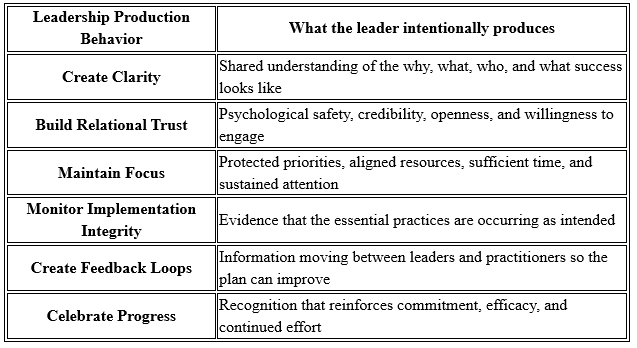
These behaviors cut across Lichtman’s eight conditions. For instance, weak commitment may require more than encouragement.
SCALE prompts leaders to ask:
Is the vision clear?
Were people meaningfully included?
Do they have the skills and resources to succeed?
Are leaders maintaining focus?
Is progress visible and celebrated?
Are feedback loops showing that people’s input matters?
The key difference
Lichtman helps a team say: “Communication appears to be missing, and people are becoming disconnected.”
SCALE moves the team toward: “What must leaders communicate, to whom, through which structures, how often, and with what opportunities for response? What observable behaviors would show that people are becoming more connected? What evidence will we review, and when will we adjust?”
In that way, SCALE turns the Stairway from a condition-identification model into a leadership production and implementation system:
· Name the desired result.
· Diagnose the behavior.
· Identify the condition.
· Select the leadership action.
· Monitor the effect.
· Learn and adjust collaboratively and inclusively.
Ultimately, SCALE helps leaders move beyond merely identifying the conditions change requires to intentionally creating, monitoring, and strengthening those conditions so that implementation becomes consistent practice and produces lasting results.
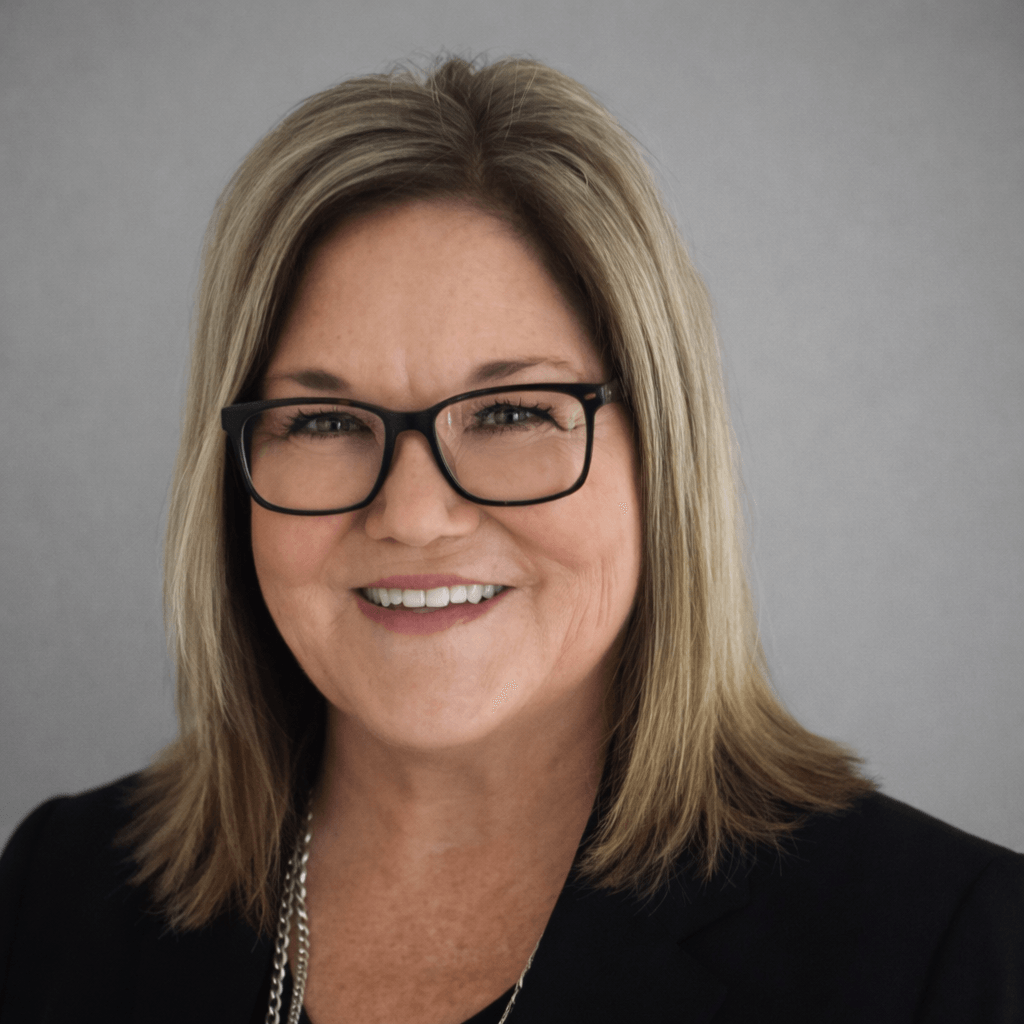
Hello, I'm Kelly Hastings!
I'm a former teacher and principal who now supports school leaders through coaching and training. As the founder of Enlightening Leadership, I help educators implement real change using the SCALE framework. I write from lived experience - always grounded, practical, and focused on what works in real schools.
Join My Newsletter List

We support principals, teacher leaders, and district administrators with coaching and training grounded in real-world experience. Through the SCALE framework and steady partnership, we help you lead with clarity, build strong teams, and bring lasting change to your school.


Resources
© Enlightening Leadership. All Rights Reserved.
Privacy Policy | Terms & Conditions
© Enlightening Leadership. All Rights Reserved.
Privacy Policy | Terms & Conditions